
Octagonal Pole Manufacturer Applications Sizes and Specifications
Learn octagonal pole applications, sizes, specifications, and key buying considerations for projects.
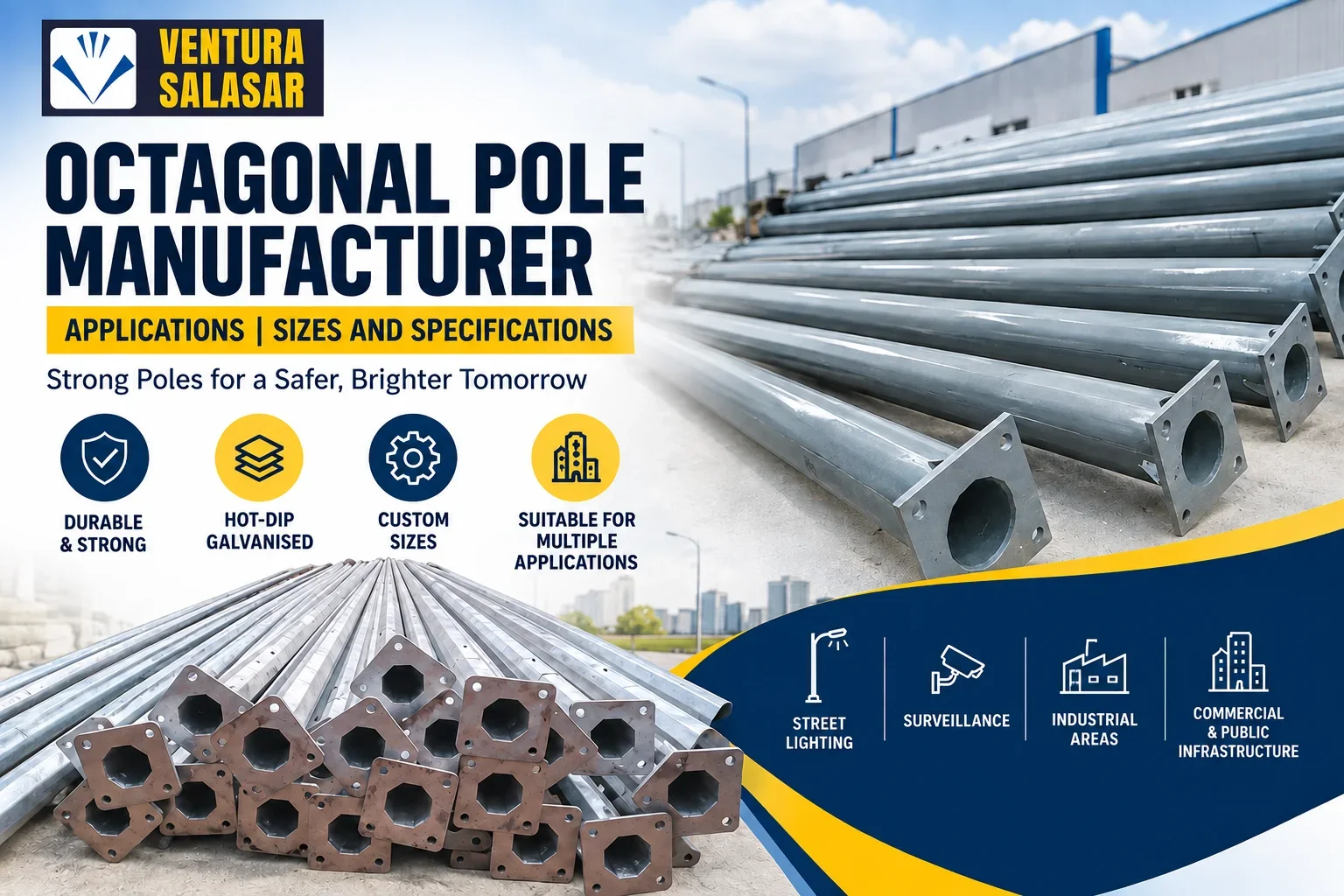
An octagonal pole may look like a straightforward street-lighting component, but it carries a great deal of responsibility. It has to hold luminaires, brackets, cameras or other equipment at the required height, remain stable under local wind conditions, resist corrosion over years of outdoor exposure, and fit the foundation, electrical and installation plan. When any one of these details is treated as an afterthought, the result can be an avoidable redesign, delay or maintenance issue.
For developers, EPC contractors, municipal bodies and industrial project teams, choosing an octagonal pole manufacturer is therefore not simply about finding the lowest rate per pole. It is about obtaining a design that works for the location, the lighting layout and the intended service life. This guide explains where octagonal poles are used, how common octagonal pole sizes are assessed, which specifications deserve attention and how to compare manufacturers with confidence.
Ventura Salasar manufactures octagonal poles for applications including street lighting, surveillance and area lighting. Its range is available from 3 m to 16 m, with project-specific accessories such as brackets, floodlight arrangements and camera mounts, along with hot-dip galvanised finishing and optional PU painting.
What should a buyer check first when selecting an octagonal pole manufacturer? Confirm the required pole height, mounted equipment, wind/design criteria, shaft and base details, foundation interface, corrosion protection, accessories, documentation and delivery scope. A technically complete quotation is more useful than a price quoted only by height.
What Is an Octagonal Pole
An octagonal pole is a tapered steel pole with eight flat faces around its cross-section. It is usually made from steel sheet, formed into its profile and longitudinally welded before being finished for corrosion protection. The eight-sided geometry provides a clean appearance and useful structural stiffness while allowing the pole diameter to reduce gradually from the base to the top.
In an installed street lighting pole, the shaft is only one part of the system. The complete assembly can include a base plate, anchor bolts, foundation, cable entry opening, service door, terminal arrangement, bracket or outreach arm, luminaire and earthing provision. The pole must be designed as a complete load-bearing element, rather than selected only on height.
Why Octagonal Poles Are Widely Used
Octagonal poles balance strength, appearance and practical fabrication. Their tapered shape can reduce unnecessary steel at the upper portion while keeping the base suitably robust. The flat faces also produce a neat finish that works well on roads, campuses and commercial sites.
They are versatile. The same basic pole concept can support LED street lights, decorative luminaires, CCTV cameras, traffic-related equipment, small signboards or solar-powered lighting assemblies. For long corridors and wide roads, the pole height, outreach and luminaire distribution are coordinated with the lighting design. For industrial premises, the focus may shift towards area coverage, safety, maintenance access and resistance to a demanding environment.
A good specification does not assume that every eight-sided pole performs alike. Shaft diameter, wall thickness, mounting arrangement, wind load, luminaire weight and corrosion-protection system all change the final design.
Applications of Octagonal Poles
Urban and residential roads
Octagonal poles are common on internal roads, local streets, avenues and township infrastructure because they provide a tidy, durable support for LED street lighting. The spacing and height should follow the lighting plan, road width and desired illumination level.
Highways and arterial roads
Major road corridors may need taller poles, longer outreach arms and carefully designed foundations. Traffic speed, median width, glare control and wind exposure are important considerations here. High-mast systems may be more appropriate at very large junctions, toll plazas or expansive interchanges.
Industrial plants and warehouses
Internal roads, loading areas, parking zones and perimeter routes benefit from dependable area lighting. Where dust, process emissions or vehicle movements are present, the project team should define finish requirements, maintenance access and equipment mounting loads early.
Airports, railways and public infrastructure
These projects often have formal technical schedules and approval requirements. Pole drawings, material traceability, galvanising records, foundation details and loading checks can be as important as the product itself.
Campuses, parks and commercial developments
A street lighting pole can support both safety and visual consistency across the site. Architectural colour, decorative brackets and coordinated luminaires are often part of the brief.
Surveillance and smart-city projects
Octagonal poles can carry CCTV cameras, communication devices and supplementary brackets when they are engineered for those loads. The equipment weight, projected area, cabling and access needs must be included in the original design rather than added informally after installation.
Solar street-lighting systems
Solar poles need to accommodate the panel, battery enclosure where applicable and luminaire loads. Because panels add wind area, structural design and foundation selection become especially important.
Common Octagonal Pole Sizes
Octagonal pole sizes are generally discussed by mounting height, but height alone is not a full specification. A 6 m pole for a light residential road and a 6 m pole carrying a heavy bracket in a high-wind coastal location will not necessarily have the same shaft diameter, wall thickness or foundation requirement.
As a broad planning reference, 3 m to 5 m poles may suit pathways, small parking areas, garden edges or low-height site lighting. Around 6 m to 9 m is commonly considered for internal roads, residential streets, parking areas and industrial circulation roads. Heights of 10 m to 12 m may be used for wider roads, large premises and more demanding area-lighting layouts. Taller street lighting pole configurations, up to 16 m in Ventura Salasar's available range, are evaluated for wider corridors and project-specific applications.
The correct choice comes from a lighting calculation and structural assessment. Required illumination, uniformity, mounting height, luminaire optics, outreach, pole spacing, wind zone and equipment load need to work together. Requesting a generic price for an '8 m pole' without these details can produce quotations that are difficult to compare fairly.
Specifications to Review Before Buying
Material and fabrication
Confirm the grade and thickness of the steel, manufacturing method, welding quality and straightness expectations. The supplier should provide a design appropriate to the stated loading conditions and applicable project standards.
Height and geometry
State the above-ground height, overall length, base and top diameter, taper, number of sections where relevant, and any required service opening. The pole should suit the intended luminaire mounting arrangement rather than force a compromise in the lighting plan.
Wall thickness and design loading
There is no universal thickness that makes every pole safe. Thickness must be considered with shaft geometry, steel grade, pole height, bracket length, luminaire weight, wind pressure, attachments and foundation response. Ask the manufacturer what loads and wind assumptions have been considered.
Base plate and foundation interface
Check base plate dimensions, bolt-circle pattern, anchor-bolt grade and projection, foundation drawing and cable-entry provisions. A pole can only perform as intended when its base connection and civil foundation are correctly executed.
Bracket and mounting details
Specify single-arm, double-arm, decorative, floodlight, CCTV or custom brackets with their projection and load. If the client may add equipment later, build that allowance into the design discussion now.
Finish and corrosion protection
Hot-dip galvanising is a common choice for outdoor steel poles because it helps resist corrosion. Ventura Salasar offers hot-dip galvanised finish and PU painting on request. In aggressive or coastal environments, clarify the expected exposure conditions, coating system and touch-up procedure.
Electrical and access provisions
Confirm service-door size and location, cable entry, earthing point, terminal box needs and protection from unauthorised access. These details influence installation speed and future maintenance.
Standards and documentation
Technical schedules may call for designs aligned with standards such as IS, BS, ASTM or AS/NZS, depending on the project. Ask for drawings, bill of materials, galvanising documentation, inspection plan and test or calculation records as required by the contract.
How to Choose an Octagonal Pole Manufacturer
Begin with project clarity. Share the site location, pole quantity, preferred height, lighting layout, luminaires, bracket drawings, wind environment, foundation scope and target delivery date. A serious manufacturer can then return a design-led proposal instead of a generic catalogue item.
Next, assess engineering capability. Can the supplier explain the shaft profile, loading basis, base plate, anchor bolts and corrosion-protection approach? Does it have in-house structural design support and the ability to coordinate custom accessories? Ventura Salasar lists structural designing, lighting designing, customised fabrication and in-house galvanising among its relevant capabilities.
Then assess manufacturing and quality control. Ask how material is sourced, welding is controlled, dimensions are checked and galvanising quality is monitored. If the project has consultant or client approvals, verify the precise approval, certification or documentation needed instead of relying on broad claims.
Finally, compare the scope, not only the price. Two quotations can look similar while differing in wall thickness, finish, foundation accessories, bracket supply, transport, testing, documentation or installation support. Put every commercial offer against the same technical schedule before deciding.
Manufacturer Comparison Checklist
Use the following questions to compare an octagonal pole manufacturer on equal terms:
1. Is the proposed pole designed for the stated height, attachments and wind conditions?
2. Are shaft dimensions, wall thickness, base plate and anchor bolts clearly listed?
3. Is hot-dip galvanising included, and is paint required for the project?
4. Are brackets, foundation accessories, terminal arrangements and service doors included or optional?
5. What drawings, calculations and inspection documents will be supplied?
6. Can the manufacturer make custom poles or accessories where standard sizes are not suitable?
7. What is the delivery lead time for the required quantity and project location?
8. Who coordinates technical queries between the electrical, civil and lighting teams?
This approach helps procurement teams avoid a common mistake: accepting a low initial quote and later discovering that necessary accessories or technical requirements were excluded.
From RFQ to Supply
A well-prepared RFQ saves time for both the buyer and manufacturer. Start with the project location and use case: a township road, industrial plant, national highway, parking area, solar application or surveillance project. Add the number of poles, desired mounting height, drawing or BOQ reference, and whether the required quantity is phased by site package.
The electrical and lighting details should be equally clear. Mention the luminaire make and weight, intended mounting configuration, outreach arm dimensions, cable route, electrical terminal requirement and earthing expectation. For a camera, floodlight or solar panel, include the product data sheet or at least the equipment weight and projected wind area. These details materially affect the structural design.
On the civil side, identify whether the manufacturer is expected to supply anchor bolts, templates and foundation accessories or only the shaft. If a foundation drawing is already approved, share it. If not, ask the supplier to state the design basis and deliverables included in its scope. Transport and unloading responsibility should also be agreed before the purchase order is issued.
Before final approval, hold a technical comparison meeting where the lighting consultant, electrical contractor, civil team and procurement team can resolve open points. This is the point to confirm the final pole schedule, finish, accessories, inspection requirements and dispatch sequence. It is far easier to settle these issues on a drawing than after poles reach site.
Octagonal Pole or Tubular Pole
Octagonal poles and tubular poles are both used for outdoor lighting, but the choice should follow the project brief rather than a cosmetic preference. An octagonal tapered shaft offers a contemporary, faceted profile and is commonly selected where a clean road or development appearance is important. Tubular poles use a round profile and can be a practical option for many standard applications.
Neither geometry removes the need for sound engineering. In either case, the manufacturer should confirm the design inputs, fabrication quality, bracket arrangement, corrosion protection and foundation connection. Where a project includes multiple site conditions, one pole type may be suitable for internal roads while another configuration may be chosen for perimeter lighting, decorative areas or special equipment. Compare the total approved scope, not the pole shape alone.
Installation and Lifecycle Considerations
Pole performance begins before dispatch. Foundations must be constructed to the approved drawing, using the correct concrete grade, anchor-bolt template, orientation and curing time. Cable routes and earthing should be planned before the base is closed. During erection, lifting points, protective packing and alignment need attention to prevent damage to the finish or base connection.
Once in service, regular visual inspections are sensible. Check for vehicle impact, loose base nuts, damaged paint, corrosion at scratches, unauthorised attachments and changes in the mounted equipment. Repainting alone is not a substitute for a suitable galvanised system, but timely treatment of local damage can help preserve the finish.
If a pole is being repurposed for cameras, signage or additional lighting, do not simply add the load on site. Reassess the structural adequacy of the pole, bracket and foundation. This is especially important for equipment with a high wind area.
Frequently Asked Questions
1. What is an octagonal pole used for?
It is used to support street lights, area lights, CCTV cameras, brackets, solar lighting equipment and other approved outdoor electrical or infrastructure fixtures.
2. What sizes are available in octagonal poles?
Sizes vary by manufacturer and project. Ventura Salasar offers octagonal poles from 3 m to 16 m; the right height depends on the lighting design, road width, loads and site conditions.
3. Which height is suitable for a street lighting pole?
There is no single answer. Lower heights can suit pathways and small areas, while 6 m to 12 m is commonly considered for roads and larger circulation areas. Confirm the final height through lighting and structural design.
4. What material is used for octagonal poles?
They are commonly fabricated from steel. Ventura Salasar describes its poles as available in mild steel and aluminium configurations; material selection should match the project specification and performance requirement.
5. Why is hot-dip galvanising important?
Hot-dip galvanising provides corrosion protection for outdoor steel. It is particularly valuable where poles face rain, humidity, pollution or long service periods.
6. Can octagonal poles be painted?
Yes. PU painting can be specified where colour, additional coating performance or site appearance is required. Ventura Salasar offers PU painting on request.
7. Can a pole carry a CCTV camera and street light together?
It can, provided the pole, bracket, foundation and wind loading are designed for the combined arrangement. Include all attachments in the original technical brief.
8. Are foundation accessories supplied with the pole?
They may be available as part of the supply scope. Confirm anchor bolts, templates, base plates and brackets explicitly in the quotation.
9. How do I compare octagonal pole prices?
Compare equivalent specifications: height, shaft geometry, thickness, material, galvanising, brackets, foundation accessories, documentation, freight and taxes. A lower rate may not represent the same scope.
10. What wind information does the manufacturer need?
Share the site location, exposure, project wind criteria and attached equipment details. These inputs influence shaft design, bracket design and foundation requirements.
11. Can poles be customised for a project?
Yes. Custom designs may include height, brackets, camera mounts, floodlight arrangements, colour, access provisions and other project-specific fittings.
12. What details should be included in an RFQ?
Include quantity, location, required height, luminaire details, bracket type, wind/design criteria, drawing requirements, finish, foundation scope and delivery schedule.
13. Do I need a lighting design before ordering poles?
It is strongly recommended. A lighting design helps set the right mounting height, spacing, optics and outreach before structural specifications are finalised.
14. How long do octagonal poles last?
Service life depends on the design, coating system, site environment, installation quality and maintenance. Specify suitable corrosion protection for the local exposure conditions.
15. Why choose Ventura Salasar for octagonal poles?
Ventura Salasar offers 3 m to 16 m octagonal poles, custom accessories, in-house galvanising and project-focused design support for lighting and infrastructure requirements.
Final Thoughts
The best octagonal pole is not the one with the most attractive base price; it is the one designed for the actual site, equipment, environment and lifecycle expectation. Start with a well-defined technical brief, use lighting and structural inputs together, and compare manufacturers on a like-for-like scope.
For a project requiring octagonal poles, street lighting brackets, foundation accessories or a custom arrangement, Ventura Salasar can help translate your site requirements into a practical supply proposal. Share the required height, quantity, location, lighting equipment and target timeline to request a technically aligned quotation.




Copyright © 2023-2026 Ventura Salasar | All Rights Reserved | Website Design, Developed & Google Promotion by VRD Creative Pvt Ltd