
Octagonal Poles for Street Lighting and Area Lighting
Explore octagonal poles for street and area lighting, including sizes, design and key specifications.
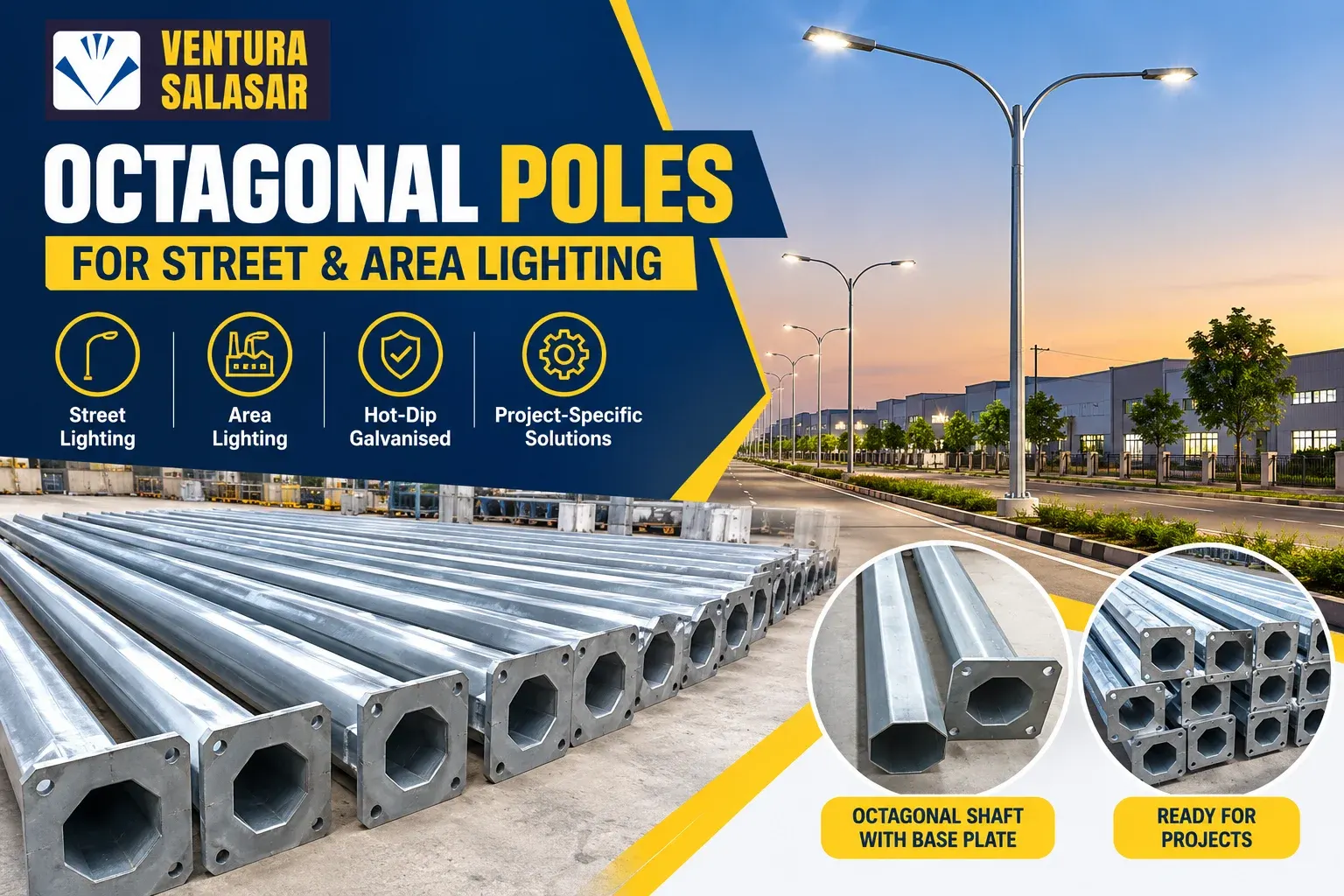
Street and area lighting depends on more than a suitable LED luminaire. The mounting height, pole spacing, outreach, roadway width, wind exposure, foundation and maintenance access all influence how the system performs after installation. An octagonal pole is the structural link between the lighting design and the site. If it is selected only by height or price, the project can face glare, poor uniformity, difficult maintenance or a pole arrangement that does not suit the installed equipment.
For EPC contractors, industrial facilities, real-estate developers and public-infrastructure teams, octagonal poles for street lighting offer a practical combination of strength, clean appearance and flexibility. They can support standard street luminaires, double-arm road arrangements, CCTV cameras, floodlights and selected smart or solar accessories when the complete loading condition is considered.
Ventura Salasar supplies octagonal poles from 3 m to 16 m for street lighting, surveillance and area-lighting projects. The range is available with hot-dip galvanised finish, optional PU painting and project-specific brackets or accessories. This guide explains how to select street lighting poles and area lighting poles that suit the actual site, rather than only a catalogue description.
What should you check before selecting octagonal poles for street lighting? Confirm the required illumination and uniformity, road or area dimensions, mounting height, luminaire optics and weight, pole spacing, bracket projection, wind/design criteria, galvanised finish, base and foundation details, cable access and maintenance plan. A complete lighting and structural brief produces a safer, more useful pole schedule.
Project Coordination Before Dispatch
Before dispatch, a short readiness check helps keep a lighting project on track. Confirm that approved drawings have been released, pole and bracket references match the schedule, foundations are ready or programmed, the delivery contact is available and unloading equipment can handle the material safely.
This coordination matters when poles, luminaires, electrical accessories and civil works are managed by different teams. It helps prevent material waiting at site, incorrect pole placement or finish damage caused by unsuitable handling. A technically correct pole reaches its full value only when the delivery and installation sequence is planned with the same care as its design.
Why Octagonal Poles Are Used for Outdoor Lighting
An octagonal pole has eight flat faces around a tapered shaft. This geometry provides a neat architectural appearance while allowing the pole profile to be engineered for the intended height, equipment and environmental loading. Compared with selecting a generic support, a project-specific octagonal pole can be coordinated with the lighting layout, the bracket type and the foundation connection.
Street lighting poles are used along internal roads, township streets, industrial circulation routes, commercial approaches and public corridors. Area lighting poles are used in parking areas, loading yards, campuses, storage zones, perimeter routes and open work areas. Although the applications are related, their lighting layouts can be different. A road needs controlled distribution along a direction of travel; an open yard may need broader coverage and careful glare control near people, vehicles or buildings.
Ventura Salasar lists octagonal poles for street lighting, surveillance and area lighting, with custom accessories such as brackets, floodlight arrangements and camera mounts. Each attachment should be part of the original specification because it affects both lighting performance and structural design.
Street Lighting and Area Lighting Explained
Street lighting is planned around a route. The designer considers road width, carriageway configuration, pedestrian movement, traffic speed, background brightness, mounting height, pole spacing and luminaire distribution. The objective is not simply high brightness; it is usable, reasonably uniform illumination with controlled glare.
Area lighting is planned around a defined space. In a parking area or logistics yard, the design may need to cover vehicle movement, pedestrians, loading activity, building entrances and security cameras. The pole arrangement can use single- or double-sided brackets, centrally located poles or perimeter-mounted equipment, depending on obstructions and site operations.
The same 9 m pole can perform very differently in these two scenarios. That is why the lighting calculation should come before the final pole schedule. It establishes where the luminaires need to sit, the required mounting height and the bracket geometry that the pole must support.
Pole Height and Spacing Selection
Pole height is one of the most visible design choices, yet it cannot be finalised in isolation. Lower poles may suit pathways, small parking areas and internal movement zones where closer spacing is acceptable. Medium-height street lighting poles are often used for residential roads, industrial lanes and larger parking areas. Taller configurations can be evaluated for wide roads, extensive yards and areas where fixtures need more reach.
Ventura Salasar offers octagonal poles from 3 m to 16 m. The appropriate height depends on luminaire optics, target illumination, pole spacing, road width, obstacles, wind environment and maintenance method. A taller pole does not automatically improve lighting: if the optics or spacing are wrong, it may increase glare or leave dark areas between fittings.
Use the lighting design to determine the mounting height and spacing together. Then provide the confirmed luminaire data, bracket length and location to the pole manufacturer. This sequence avoids the common problem of buying poles first and trying to force the lighting layout around them later.
Luminaire Brackets and Equipment Loads
The pole shaft is only one part of a street lighting assembly. A single-arm bracket, double-arm bracket, decorative arm, CCTV camera, solar panel or floodlight arrangement changes the load on the pole. Bracket projection creates a moment at the shaft and base, while attached equipment also adds wind area.
For road lighting, the bracket positions the luminaire over the carriageway and can be as important as the shaft height. The wrong outreach can move the light away from the intended zone, while an unapproved extension can change the structural loading. For area lighting, floodlights and cameras may require a different mounting arrangement and access plan.
Provide the luminaire make, model, weight, dimensions, bracket drawing and any future accessory requirements with the RFQ. Ventura Salasar can provide associated brackets and foundation accessories on request. Defining the full arrangement early allows the shaft, bracket, base plate and foundation to be reviewed as one coordinated system.
Galvanized Poles and Outdoor Durability
Street lighting poles remain outdoors throughout the year. Rain, humidity, dust, airborne pollutants and local exposure conditions can affect the steel surface over time. Hot-dip galvanising is a widely used corrosion-protection finish for outdoor steel poles and should be specified as a clear project requirement.
Ventura Salasar lists hot-dip galvanised finishing for its octagonal poles and PU painting on request. Painting may be useful where a specific colour, an architectural treatment or an additional coating system is required. The right finish should be chosen with the service environment and maintenance expectation in mind.
A galvanised pole is not only a finish choice; it is part of lifecycle planning. Confirm how damaged areas will be treated during erection, whether any site painting is required, and who will protect the finish during loading, unloading and installation. These practical details help retain the value of the pole after dispatch.
Structural Design Wind and Foundation Inputs
A lighting pole must resist the forces created by its own weight, attached equipment and wind. The required shaft dimensions and wall thickness are affected by pole height, steel grade, taper, luminaire and bracket load, wind pressure and the foundation response. There is no universal thickness that is correct for every street lighting pole.
The foundation interface needs the same attention. Base-plate dimensions, anchor-bolt pattern, bolt grade, template, concrete foundation, cable entry and pole orientation must all correspond to the approved drawing. A correctly designed shaft can still perform poorly if the foundation is incorrectly set or the anchor bolts do not match the base plate.
Share the site location, wind/design criteria, attachment details and foundation scope before ordering. Ventura Salasar states that its poles can be designed to required standards including BS, IS, AS/NZS and ASTM. The exact project standard, consultant requirement and supporting documentation should be confirmed in writing at the enquiry stage.
Lighting Design and DIALux Coordination
A lighting design converts the project brief into a working pole layout. It tests how luminaire output, optics, mounting height, tilt, bracket arrangement and spacing affect illumination, uniformity and glare. For commercial and infrastructure projects, the resulting calculation provides a useful basis for finalising pole positions before civil work begins.
DIALux or similar photometric software is commonly used to model roads, parking areas and open sites. The important point is not the software name alone; it is the quality of the inputs. The model should represent the site geometry, surface assumptions, obstructions, pole locations and actual luminaire photometry.
Ventura Salasar lists lighting designing and structural designing among its services. When a project requires a detailed lighting calculation, coordinate the lighting designer, pole manufacturer, civil team and electrical contractor. This reduces gaps between the layout drawing, pole schedule, foundation plan and installation sequence.
Applications Across Projects
Townships and residential developments
Octagonal street lighting poles can create a consistent visual language across roads, pedestrian links, parks and parking zones. Heights and brackets should match the road hierarchy, not be repeated blindly throughout the site.
Industrial facilities and warehouses
Internal roads, truck movement areas, gates, parking and loading zones need lighting that supports safe operations without creating glare for drivers or operators. Area lighting poles may also carry cameras or security fixtures.
Commercial campuses and institutions
Entrances, driveways, walkways and open grounds often need a balance of safety, wayfinding and architectural appearance. Optional PU paint and decorative bracket details can be considered where the project brief calls for them.
Public infrastructure
Roads, transport areas, public parking and civic precincts can require formal drawings, galvanising documentation, inspection records and approvals. Confirm the technical schedule and quality requirements before production begins.
Solar and surveillance projects
A solar panel or camera changes the equipment load and wind area. These additions should never be treated as an afterthought; they must be designed into the pole and foundation arrangement.
How to Select a Manufacturer and Compare Quotes
Start with a complete technical brief. Include site location, quantity, required pole height, pole layout, luminaire details, bracket type, wind/design criteria, galvanised finish, paint requirement, foundation scope, delivery point and target schedule. If the project has a consultant or authority requirement, attach the relevant specification.
When comparing suppliers, check more than the per-pole price. Compare shaft geometry, material and thickness, base plate, anchor bolts, galvanising, brackets, service-door details, electrical access, drawings, documentation, freight and taxes. A low offer may exclude accessories or use assumptions that do not match the project.
Ventura Salasar provides poles across a 3 m to 16 m range with custom accessories and in-house galvanising. For B2B buyers, the strongest supplier relationship is one where the manufacturer can respond clearly to technical queries and align the proposed scope with the lighting, structural and delivery requirements.
Documentation Procurement and Delivery Planning
A good pole schedule should travel with the purchase order. It should identify the pole reference, quantity, mounting height, shaft and base details, bracket arrangement, finish, accessories, site location and required documentation. For a consultant-led project, include the approved drawings, technical specification and inspection requirements so that every party is working to the same reference.
Ask the manufacturer to state what drawings, material details, galvanising records, inspection documents or design information are included. If the poles are required in phases, include the dispatch sequence and site-wise quantities in the order. This is especially important on large projects where civil foundations and electrical cabling may be completed in different areas at different times.
Delivery scope should also be clear. Confirm freight, unloading responsibility, packaging, lifting restrictions and site access. Poles are long structural items; safe handling protects the shaft, bracket and finish before installation. This procurement discipline makes it easier for the project team to track material, resolve technical queries and avoid waiting time at site.
Installation Commissioning and Maintenance
Pole installation begins with the foundation. The anchor-bolt template must be set accurately, the concrete must achieve the required condition, and cable routes and earthing should be planned before erection. During lifting, use appropriate handling methods to avoid damaging the galvanised finish, bracket or base connection.
After installation, verify pole alignment, bolt tightening, earthing, cable connections, service-door security and luminaire orientation. For a road-lighting project, commissioning should also confirm that the built layout matches the approved drawing. A small change in bracket direction or luminaire tilt can affect glare and uniformity.
Routine inspections should look for impact damage, loose fasteners, paint damage, corrosion at scratches, unauthorised attachments and changes to mounted equipment. If a camera, sign or additional luminaire is proposed later, review the original design before adding it. The pole, bracket and foundation must remain adequate for the combined load.
Common Selection Mistakes
Choosing by height alone
Height must be linked with luminaire optics, spacing, road width and equipment load.
Finalising poles before the lighting layout
This can force poor spacing or unsuitable brackets after fabrication.
Ignoring brackets and wind area
Cameras, solar panels and floodlights need to be part of the structural brief.
Comparing incomplete quotations
Check galvanising, anchor bolts, brackets, documentation, freight and taxes before deciding.
Treating the foundation as a separate afterthought
The base connection is integral to pole performance and safety.
Adding equipment later without review
Any additional load may require a new structural assessment.
Frequently Asked Questions
1. What are octagonal poles used for in street lighting?
They support street luminaires, brackets, cameras, solar fixtures and related outdoor equipment on roads, campuses, industrial sites and public areas.
2. What height is suitable for street lighting poles?
The suitable height depends on road width, luminaire optics, required illumination, spacing, bracket projection and site conditions. Ventura Salasar offers poles from 3 m to 16 m.
3. What is the difference between street lighting and area lighting poles?
Street lighting is arranged along a route, while area lighting covers an open space such as a parking area, yard or loading zone. Their pole positions and bracket arrangements can differ.
4. Why are octagonal poles preferred for outdoor lighting?
Their tapered eight-sided profile provides a clean appearance and can be engineered for the intended height, attachments, wind conditions and foundation arrangement.
5. Are octagonal poles galvanised?
Ventura Salasar offers hot-dip galvanised finish for octagonal poles. This helps provide corrosion protection for outdoor steel applications.
6. Can octagonal poles be painted?
Yes. PU painting is available on request when the project needs a specified colour or additional coating treatment.
7. Do brackets affect pole design?
Yes. Bracket length, type and attached luminaire load affect the forces on the shaft and base connection.
8. Can a pole support CCTV cameras and lights together?
It can when the camera, light, bracket and wind loads are included in the structural design from the start.
9. Do solar panels affect pole specifications?
Yes. Solar panels add weight and wind area, so the pole and foundation must be selected for the complete system.
10. What information should be included in an RFQ?
Include quantity, location, height, luminaire data, brackets, design criteria, finish, foundation scope, delivery requirements and documentation needs.
11. Are foundation accessories included with the pole?
They may be included or quoted separately. Confirm anchor bolts, templates, base details and foundation accessories in the final scope.
12. Why is lighting design important before ordering poles?
It establishes the required mounting height, spacing, luminaire orientation and bracket arrangement before the pole schedule is finalised.
13. How do I compare street lighting pole quotations?
Compare equivalent specifications, including shaft dimensions, steel, galvanising, accessories, drawings, freight and taxes, not only the per-pole rate.
14. Can poles be supplied for project-specific standards?
Ventura Salasar notes designs can be made to required standards including BS, IS, AS/NZS and ASTM. Confirm the exact project requirement before ordering.
15. Why choose Ventura Salasar for octagonal poles?
Ventura Salasar offers 3 m to 16 m octagonal poles, custom accessories, hot-dip galvanising and technical support for street lighting, area lighting and infrastructure applications.
Final Thoughts
Well-planned octagonal poles for street lighting support more than a lighting fixture. They help connect the design intent, site conditions, structural requirements and long-term maintenance plan. The right pole schedule is created when the lighting layout, luminaire details, brackets, wind criteria, foundation and finish are considered together.
For street lighting poles, area lighting poles, galvanized poles, brackets or foundation accessories, Ventura Salasar can help prepare a project-aligned proposal. Share your layout, pole quantity, site location, luminaire information and delivery timeline to receive a technically clear quotation.




Copyright © 2023-2026 Ventura Salasar | All Rights Reserved | Website Design, Developed & Google Promotion by VRD Creative Pvt Ltd